Showing posts with label copyright. Show all posts

Wednesday, April 22, 2009

Trusted Computing

Computing industry successfully control the use and access to a large part of the market software. But what if they extend their grip to the hardware? This is what Trusted Computing is about.

"Trusted Computing (TC) is a technology developed and promoted by the Trusted Computing Group.[1] The term is taken from the field of trusted systems and has a specialized meaning. With Trusted Computing, the computer will consistently behave in specific ways, and those behaviors will be enforced by hardware and software.[1] Enforcing this Trusted behavior is achieved by loading the hardware with a unique ID and unique master key and denying even the owner of a computer knowledge and control of their own master key. Trusted Computing is extremely controversial as the hardware is not only secured for the owner, but also secured against the owner as well." (Wikipedia)

Again, the industry's use of specific a term with a strong positive connotation to enforce their control over computer is quite clever. According to Stephan and Vogel, trust is:

"Trust
Trust is the personal believe of correctness of something.

It is the deep conviction of truth and rightness, and cannot be enforced.

If you gain someone's trust, you have established am interpersonal relationship, based on communication, shared values and experiences." (Stephan & Vorgel, 2006)
If you can trust a computer, then it is more secure. This is the idea that the industry try to promote. But more secure usually means less freedom. The industry want to "secure" the computer and technological gadget so they can monitor their activity and ensure that they are used in a manner that reflect their vision. As Stallman said "they do not mean what we normally mean by that word: protecting your machine from things you do not want. They mean protecting your copies of data on your machine from access by you in ways others do not want." (2002). This technology is likely to be use to enforce Digital Right Management and block interoperability with non "trusted" computer.

Again, the industry is investing people's private life, dictating what they can and cannot do with the available information. The more they "secure" the technologie, the more "freedom" we lose.

I invite you to check this quick video on trust computing:


1. “Trusted Computing - Wikipedia, the free encyclopedia,” http://en.wikipedia.org/wiki/Trusted_Computing#cite_note-anderson2-1.

2. Stephan, Benjamin and Lutz Vogel, Trusted Computing, 2006, http://www.youtube.com/watch?v=UnXU7z2_6Jg.

3. Richard Stallman, “Can You Trust Your Computer?,” GNU Project - Free Software Foundation, 2002, http://www.gnu.org/philosophy/can-you-trust.html.





Friday, April 17, 2009

I am losing control of my Internet: net neutrality at stake.

I've realize that, more and more, old institutions and industry agents are trying to shape to way the Internet is use and perceive, and they are putting lots of energy in it. Changes will affect those that are actively using internet, and I think we will move slowly toward a web 2.1: A web "more secure" controlled by large corporation where the users is thrown back to the seat of the spectator, as in old media.

Internet did change our relationship to media and information. User and produced were for a time indistinguishable. People did build a chaotic but democratic sharing of information. Anyone could see and download anything, anytime. This is not true anymore. The traditional media enterprise, that at first neglect Internet as a marginal source of information and spectacle, is now claiming back the industry that is slipping through their hands. They want to secure over the Internet the power they have over traditional media channel. "The chaotic realm of the internet needs to be ordered. "

Lots of energy, and money, is put into this attempt to take back the power from the users. The recent Pirates Bay trial is only an example. Record and movie industry are in court everywhere in the world to claim back their place in the distribution process of cultural products. Internet Service Providers (ISPs) are capping traffic, inspecting it with new deep packet inspection technology and assigning different speed depending of your activity. Bell Canada assigned capped speed to sharing protocol during peak hours. In order to achieve this, they need to inspect the traffic, which seems to me a major violation of privacy. Moreover, they are not only assigning those restrictions to their customers, but also to their resellers. Since Bell own the DSL network, if you are using a DSL modem chance are you traffic is inspected and capped.

Why are they capping the file-sharing protocol? Not only because it is the main channel of pirated file sharing, but also because it is a channel that they have no control over it. They rather you use their web service, and thus bring back home their customers. In a not so distant future, they will probably charge depending the services you will be using: youtube, itune, amazon, etc. like the cable TV. Content provider will need to be large corporation, or they will just disappear. Soon enough, producer of content and users will be two distinct categories. This issue has been known for several years as the net neutrality problematic.

What option is left for the user? They can’t really turn to government. Recent events showed that they will take the side of their traditional allied. CRTC already reject injunction against Bell’s traffic throttling. Sweden court applied American copyrights law to the Pirate Bay’s case, despite a really clever defense on their part, one that shown a better understanding of new technology.

Government doesn’t want the citizen to be in control of those new technologies. They are letting corporation take this control out of our hand, and soon we will be charged more and more to use it.

Pirate Bay guilty

I don't know if you were aware of the trial surrounding the larger torrent tracker, the Pirate Bay. You might like to know that they just got fined and jailed. This news will bring an important shift in the way copyright and intellectual property will apply to the digital world. The court just enforce old law to new phenomenon, forcing their categories to brand new concept. Quite the radical opposite of Trent Reznor view of the problem.

Old institutions can't really evolve, can they?

Court jails Pirate Bay founders

A court in Sweden has jailed four men behind The Pirate Bay (TPB), the world's most high-profile file-sharing website, in a landmark case.

Frederik Neij, Gottfrid Svartholm Warg, Carl Lundstrom and Peter Sunde were found guilty of breaking copyright law and were sentenced to a year in jail.

They were also ordered to pay $4.5m (£3m) in damages.

Record companies welcomed the verdict but the men are to appeal and Sunde said they would refuse to pay the fine.

Speaking at an online press conference, he described the verdict as "bizarre.

"It's serious to actually be found guilty and get jail time. It's really serious. And that's a bit weird," Sunde said.

"It's so bizarre that we were convicted at all and it's even more bizarre that we were [convicted] as a team. The court said we were organised. I can't get Gottfrid out of bed in the morning. If you're going to convict us, convict us of disorganised crime.

"We can't pay and we wouldn't pay. Even if I had the money I would rather burn everything I owned, and I wouldn't even give them the ashes."

It is almost certain that The Pirate Bay will keep on sailing, long after today's court judgement

The damages were awarded to a number of entertainment companies, including Warner Bros, Sony Music Entertainment, EMI, and Columbia Pictures.

However, the total awarded fell short of the $17.5m in damages and interest the firms were seeking.

Speaking to the BBC, the chairman of industry body the International Federation of the Phonographic Industry (IFPI) John Kennedy said the verdict sent out a clear message.

"These guys weren't making a principled stand, they were out to line their own pockets. There was nothing meritorious about their behaviour, it was reprehensible.

"The Pirate Bay did immense harm and the damages awarded doesn't even get close to compensation, but we never claimed it did.

"There has been a perception that piracy is OK and that the music industry should just have to accept it. This verdict will change that," he said.

The four men denied the charges throughout the trial, saying that because they did not actually host any files, they were not doing anything wrong.

A lawyer for Carl Lundstrom, Per Samuelson told journalists he was shocked by the guilty verdict and the severity of the sentence.

"That's outrageous, in my point of view. Of course we will appeal," he was quoted as saying by Reuters news agency. "This is the first word, not the last. The last word will be ours."

Political issue

Rickard Falkvinge, leader of The Pirate Party - which is trying to reform laws around copyright and patents in the digital age - told the BBC that the verdict was "a gross injustice".

"This wasn't a criminal trial, it was a political trial. It is just gross beyond description that you can jail four people for providing infrastructure.

"There is a lot of anger in Sweden right now. File-sharing is an institution here and while I can't encourage people to break copyright law, I'm not following it and I don't agree with it.

"Today's events make file-sharing a hot political issue and we're going to take this to the European Parliament."

The Pirate Bay is the world's most high profile file-sharing website and was set up in 2003 by anti-copyright organisation Piratbyran, but for the last five years it has been run by individuals.

Millions of files are exchanged using the service every day.

No copyright content is hosted on The Pirate Bay's web servers; instead the site hosts "torrent" links to TV, film and music files held on its users' computers.

Story from BBC NEWS:
http://news.bbc.co.uk/go/pr/fr/-/1/hi/technology/8003799.stm

Published: 2009/04/17 12:32:07 GMT

© BBC MMIX

Wednesday, April 15, 2009

Wikipedia licensed under GPL

I just notice that the online encyclopedia Wikipedia is licensed under the General Public License (GPL). This is the same license used for Free Software (free as in freedom, libre). This license made a schism in Free/Open Source Software movement. Both Free license (GPL) and the Open Source license (the most known is the BSD license) permit modification and distribution, BUT the GPL required that every re-distribution be published under the same license.

For example, if you want to take a part of code from a GPL licensed program to include it in closed-source software, you will need to publish it under the GPL license and make it open. That's the reason that the GPL license is called "viral license" (Weber, 2005: 53).

In sum, if you take citation from Wikipedia, you should make your paper available under the GPL license.

Weber, Steven. 2005. The Success of Open Source. Cambridge: Harvard University Press.


Tuesday, April 14, 2009

The making of closed source software

The history of free and open source software isn't one where closes source software were liberated and became free and open. Actually, it is quite the opposite. There was a time, when there's was no distinction between hardware and software, between users and programmers that hobbyists shared freely their knowledge. No one wanted to reinvented the wheels each time they used a computer. so they collaborated and share their lines of code.

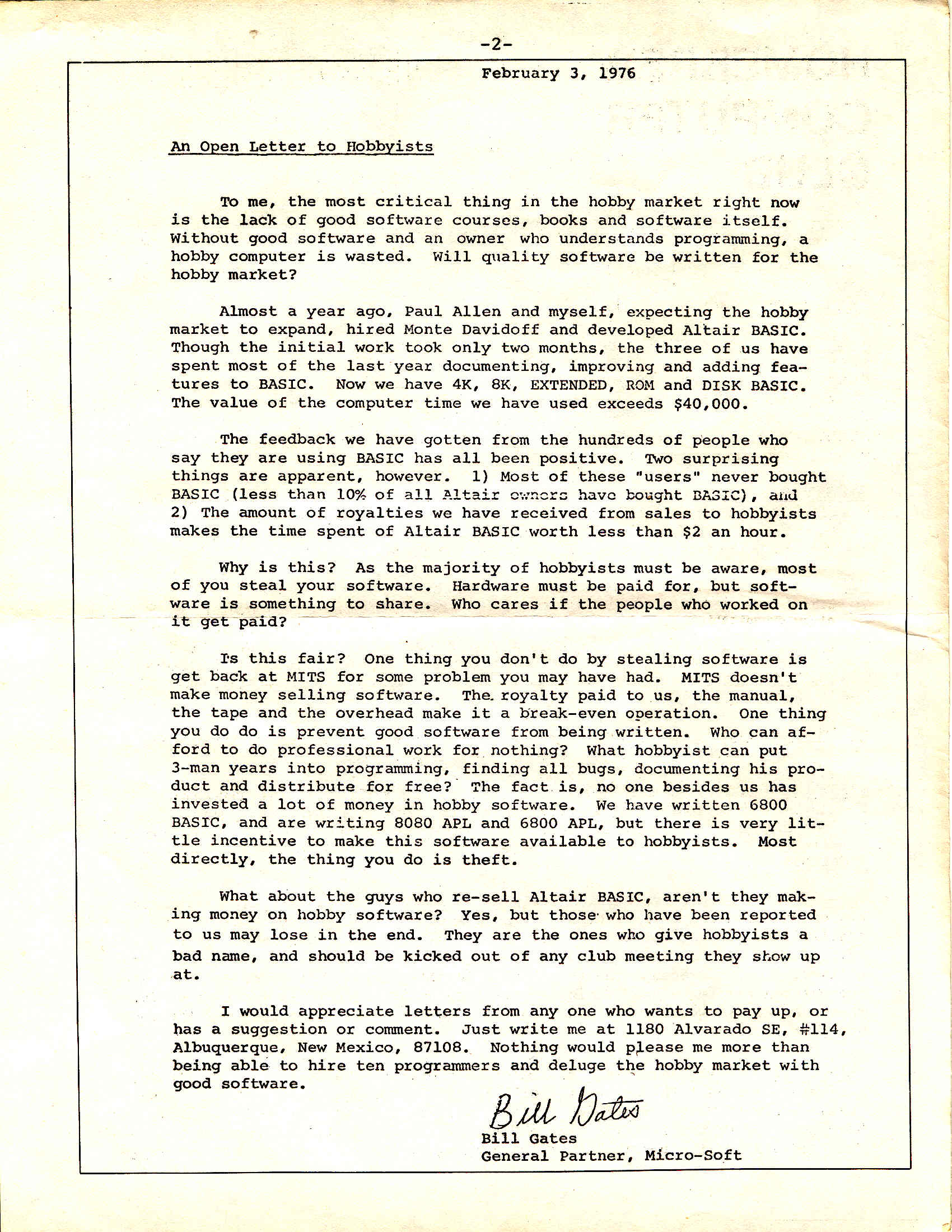
This early history of computing came to an abrupt end when Bill Gates from Micro-soft send an open letter to the Homebrew Computer Club.


AN OPEN LETTER TO HOBBYISTS

By William Henry Gates III

To me, the most critical thing in the hobby market right now is the lack of good software courses, books and software itself. Without good software and an owner who understands programming, a hobby computer is wasted. Will quality software be written for the hobby market?

Almost a year ago, Paul Allen and myself, expecting the hobby market to expand, hired Monte Davidoff and developed Altair BASIC. Though the initial work took only two months, the three of us have spent most of the last year documenting, improving and adding features to BASIC. Now we have 4K, 8K, EXTENDED, ROM and DISK BASIC. The value of the computer time we have used exceeds $40,000.

The feedback we have gotten from the hundreds of people who say they are using BASIC has all been positive. Two surprising things are apparent, however, 1) Most of these "users" never bought BASIC (less than 10% of all Altair owners have bought BASIC), and 2) The amount of royalties we have received from sales to hobbyists makes the time spent on Altair BASIC worth less than $2 an hour.

Why is this? As the majority of hobbyists must be aware, most of you steal your software. Hardware must be paid for, but software is something to share. Who cares if the people who worked on it get paid?

Is this fair? One thing you don't do by stealing software is get back at MITS for some problem you may have had. MITS doesn't make money selling software. The royalty paid to us, the manual, the tape and the overhead make it a break-even operation. One thing you do do is prevent good software from being written. Who can afford to do professional work for nothing? What hobbyist can put 3-man years into programming, finding all bugs, documenting his product and distribute for free? The fact is, no one besides us has invested a lot of money in hobby software. We have written 6800 BASIC, and are writing 8080 APL and 6800 APL, but there is very little incentive to make this software available to hobbyists. Most directly, the thing you do is theft.

What about the guys who re-sell Altair BASIC, aren't they making money on hobby software? Yes, but those who have been reported to us may lose in the end. They are the ones who give hobbyists a bad name, and should be kicked out of any club meeting they show up at.

I would appreciate letters from any one who wants to pay up, or has a suggestion or comment. Just write me at 1180 Alvarado SE, #114, Albuquerque, New Mexico, 87108. Nothing would please me more than being able to hire ten programmers and deluge the hobby market with good software.


Bill Gates

General Partner, Micro-Soft


This letter is a major schism in the discursive formation of copyright (to embrace some Foucault's notion). This letter bring a fundamental change in the discursive field where hardware and software aren't one anymore, and if you pay for the former, you have to pay for the later too. Programmers and users aren't one either. The first one is working and the later use the product, therefore he needs to pay for it. Those notion seems like self-going today, but they are made out, and the root can be trace back to this very letter, where Bill Gates accused hobbyists of stealing software.


DigiBarn Newsletters: Bill Gates' Open Letter to Hobbyists in Homebrew Club Newsletter Vol 2, Issue 1 (Feb 3, 1976). http://www.digibarn.com/collections/newsletters/homebrew/V2_01/gatesletter.html.


Foucault, Michel. 1969. L'archéologie Du Savoir. Bibliothèque des sciences humaines. Paris: Gallimard.


Gates, Bill. 1976. An Open Letter to Hobbyists. Homebrew Computer Club newsletter 2, no. 1 (February 3): 2.


Saturday, April 11, 2009

Trent Reznor on music industry

I found this recent interview with Trent Reznor from Nine Inch Nail talking about his decision to publish his latest album under Creative Commons licenses.

This interview is from the Digg Dialogg show, where the digg community is asked to submit and vote question to be ask.

Reznor's answer to the first question is quite insightful on the way internet may change copyright and intellectual property in the future:

"Trent - you've embraced Creative Commons and file sharing, but your business model (aside from touring) still primarily involves selling music either digitally or physically. Why haven't you embraced advertising as a business model, e.g. placing ads on your torrent tracker? Why let Pirate Bay take all the ad revenue you deserve? Furthermore, why aren't you building a brand new record label based on a modern business model?"

Check out the video for his answer.


You can check the whole list of questions here.

EDIT: video doesn't fit well on the blog, visit digg dialogg web page to see it all.

Wednesday, February 18, 2009

Hacker and Community, part 2/2: Defining Community

Writing about community reveals to be far more complicate than I firstly anticipated, maybe because I am trying to bit off more than what I can chew. I tried so far to enlace too many people in what I considered to be the F/OSS community. On one side, you have multiple “hackers’” community revolving around various projects, and on the other, you have users taking the most out of the system. They do share common goals: adapt the system to fit their needs. On the other hand, their practices to do so are completely different.

There is also the question of “space”. Do they share the same locus? Yes and no. Some platform and website are dedicated to development, while other are oriented for support and community chat. It is not rare to see “hacker” engaging himself on support and community forum and discussion list. After all, “hackers” are also users. On the other side, the open source nature of the various project make it easy for users to participate in various development task, e.g. doing translation. Hence the borders between those spaces are blurred by the flow of individual that goes from one to the other. Thus, “locus” can hardly be taken as criteria to delimit communities boundaries.

One of the interesting reading I made refer to Ubuntu hackers as a community of practice. Andreas Lloyd’s approach is very relevant. Here’s a big chunk of his thesis:

“In examining the Ubuntu hackers' day­to­day practices, I argue that the Ubuntu hackers’ shared use and development of the Ubuntu system constitutes a community of practice around their collaborative work and commitment to the project. By positing the Ubuntu community as a community of practice, I explore how the Ubuntu hackers are using new technical and social means to manage and share knowledge and skills on­line, and how these means of learning and sharing are reflected in the system itself. 

I argue that though the Ubuntu community offers complete access to every technical detail of the transparent system they develop, the social boundaries of this on­line community are defined through the active use and development of the system itself. Because of this, membership and participation in this community is gained through a shared history of learning the specialized knowledge and social norms this use and development requires, making the group of developers a meritocratic group joined only through dedicated collaborative work. Thus, despite the Ubuntu system solely consisting of free software, the freedom it offers can only be fully appreciated by hackers capable of developing it. For this group of hackers, the Ubuntu system is the all­encompassing means offering them the freedom to fulfil their diverse personal, social motivations for contributing to the system. By building a system that works for each of them individually, the Ubuntu hackers come to construct a system which reflects their practices. But they also seek to ensure that the Ubuntu system, as well as the community of practice through which it is built, is open to all, depending on the users’ willingness to invest the time and effort to scale the steep curve of learning necessary to adopt, learn, configure, and even build the system according to their own needs, and master the core practices and social norms required for membership. 

I argue that this shared practice and history of learning to collaboratively build and maintain the Ubuntu system results in a careful mutual trust in the hackers’ complementary abilities through which the integrity and solidity of the intricately complex Ubuntu system is guaranteed, and which the many users of the Ubuntu system come to rely on. And similarly, it is through this reciprocal trust that the diversity of motivations and conflicting interests within the community of practice is managed under the reciprocal big­man leadership and ethos of a few prominent and respected core Ubuntu developers.” (Lloyd, 2007 : 10-11)

While it covers well the hackers’ uses of Ubuntu, I feel it won’t suffice for my needs. In order to look at software as contestation tools against copyright, authorship and intellectual property, the concept of community of practice might be short of use. Some authors (Szczepanska et al., 2007) approach the community identity's question using a foucaultian analyze of discourse. They argue that discours provide understanding on how collective identity is created and communicated. 

“Developing discourses is vital for providing the members of the [open source] movement with a meaningful context that enables creative software development activities across organizational and geographical boundaries. People feel a bond with others not because they share the same interest, but because they need that bond in order to make sense of what they are doing. Discourses […] enable members of a community to affirm themselves as subjects of their action and parts of a collective action.” (Szczepanska et al., 2007: 433)


Contestation discourse might reveal lots of information on the community’s nature and the bonds that tie them. I expect contestation to be a pivotal element to define open source movement as a whole. In this sense, it might also tie together different members, users and hackers, in the same community.


References
  • Andreas, Lloyd. 2007. A System that Works for me: an anthropological analysis of computer hacker' shared use and development of the Ubuntu Linux system. Master's thesis, University of Copenhagen. Available here.
  • Szczepanska, Anna Maria, Magnus Bergquist, and Jan Ljungberg. 2007. High Noon at OS Corral: Duels and Shoot-Outs in Open Source Discourse. In Perspectives on Free and Open Source Software, ed. Joseph Feller, Brian Fitzgerald, Scott A. Hissam, and Karim R. Lakhani. Cambridge, Massachusetts: The MIT Press.

Tuesday, January 27, 2009

About Apple's DRM

I stumble upon this, which might clarified the question raised yesterday on the new DRM-free itune's song:
Does the lack of DRM mean that it’s okay to give copies of the songs I buy to my friends?

No, copyright law is still in effect—passing songs around is music piracy. However, the lack of DRM allows you as the consumer to be the judge of what’s right and what’s wrong, giving you a flexibility that DRM couldn’t. For example, imagine parents and kids co-mingling their music libraries. That seems absolutely fair to us, although in many cases quite unlikely. And if you opt to share your iTunes library on your local network, others can stream the songs you’ve purchased from the iTunes Store (currently people can see them, but if they double-click on a song to play it, they’re prompted to authorize their computers to be able to listen). But putting a song up on a file-sharing service and letting 20 of your friends download it? That’s now possible, but not exactly ethical. (And it’s fair to note that iTunes does embed your iTunes ID in every iTunes plus file you download, so it’s easy to see who bought the file originally.)

It is effectively easier to share song, but your name is tagged to the file so you cannot upload the song with impunity. You can check out the whole FAQ on 

On another note, I guess Apple remove the DRM because it was hard/impossible for legitimates customers to use their file the way they want while users of pirated version could use their material without restriction. In my opinion, DRM was encouraging piracy rather than hinder it. Buying music felt like a real rip off (it may still does though...)