Showing posts with label hacker. Show all posts

Tuesday, April 14, 2009

Open Source Economic Model

One may wonder why would someone invest time and money into software that is going to be given away. Profitability of the Open Source model always has been a major source of questions. In a recent study, about 38% of the programmers involve in open source were paid for collaborating in those projects (Lakhani and Wolf, 2007: 9). Who's paying those developers to build new software? Ubuntu server host thousands of gigabytes of data that all the users can access freely. All this has a cost, and someone need to pay for it.

The open source economic model can be divided in two aspects: why does company pay for developing open source software, and how corporation like Canonical, the corporation behind the Ubuntu project, intend to profits on building such a project.

First of all, to understand why a company would invest in open source development, we need to take the point of view of the client. With proprietary software, large enterprises are paying large amount of money for licenses, so they get involve in open source project for their own benefits. Software only have a marginal cost for distribution, so all the money made through the selling is profit once the development has been paid for. Large companies, exploiting thousands of workstation are paying a large share for the development of a product. And they can't influence the final product.

That's the reason that many of them, instead of paying for license, are paying developers to help improve Open Source project. The final product of Open Source project doesn't have a licensing cost, so all they have to do is to pay for the developer. Moreover, having their own developer on the project give them the opportunity to influence and control the final product through their participation, a power that they would not have through proprietary software.

Often many corporations have developers involved in a project. In those cases, we can affirm that open source development is mutually funded. Since most corporation involved aren't selling the software, but using it to improve their productivity, there is no reason not to cooperate (Moreira de Sa Coutinho, 2006).

The second reason a corporation will get involve in funding of open source projects is the derived service they intend to sell. For example, Canonical Corporation have been funding the Ubuntu project since the beginning and has yet to see profitability, but they expect to meet it soon (Shankland 2008). How? By selling support service to corporation. As Krishnamurthy put it:

"Enterprises are willing to pay for accountability. When they have a problem, they do not want to send a message to mailing list and wait for support that may or may not be of the highest quality. They have no interest in sifting through technical FAQs to find the answer. Therefore, there is money to be made in services such as support for installation, answering technical questions and training employees to use the product."(2007: 283)


Enterprises are also willing to pay for long-term agreements with distributors to ensure that their products get updated regularly. This is what Canonical Corporation is exploiting. Selling desktop software isn't an option anymore, as Mark Shuttleworth, the founder of Ubuntu and Canonical note it:

"I don't think it will possible to make a lot of money, or maybe any money, selling the desktop. We're not going to try to make money selling the desktop. We force ourselves to look to services-oriented business models. I remain confident this is the right business model for the industry. Linux is the forcing function that (means) the broader software industry will shift in business models away from licensing the bits and to services." (Cited in Shankland 2008)


So far, this has been a viable economic model that is growing and getting more and more success. Open source software is not only for hobbyist anymore and business can be build around those models.

Krishnamurthy, Sandeep. 2007. An Analysis of Open Soure Business Models. In Perspectives on Free and Open Source Software, ed. Joseph Feller, Brian Fitzgerald, Scott A. Hissam, and Karim R. Lakhani, 267-278. Cambridge, Massachusetts: The MIT Press.


Lakhani, Karim R., and Robert G. Wolf. 2007. Why Hackers Do What They Do: Understanding Motivation and Effort in Free/Open Source Software Projects. In Perspectives on Free and Open Source Software, ed. Joseph Feller, Brian Fitzgerald, Scott A. Hissam, and Karim R. Lakhani, 3-21. Cambridge, Massachusetts: The MIT Press.


Moreira de Sa Coutinho, Joao. 2006. Le logiciel libre (1) Aboutissement du Capitalisme. March 4. http://www.domainepublic.org/capitalisme.html.


Shankland, Stephen. 2008. Ubuntu 8.10 due Thursday. Profits? Not so fast. Business Tech - CNET News. October 27. http://news.cnet.com/8301-1001_3-10075890-92.html.

The making of closed source software

The history of free and open source software isn't one where closes source software were liberated and became free and open. Actually, it is quite the opposite. There was a time, when there's was no distinction between hardware and software, between users and programmers that hobbyists shared freely their knowledge. No one wanted to reinvented the wheels each time they used a computer. so they collaborated and share their lines of code.

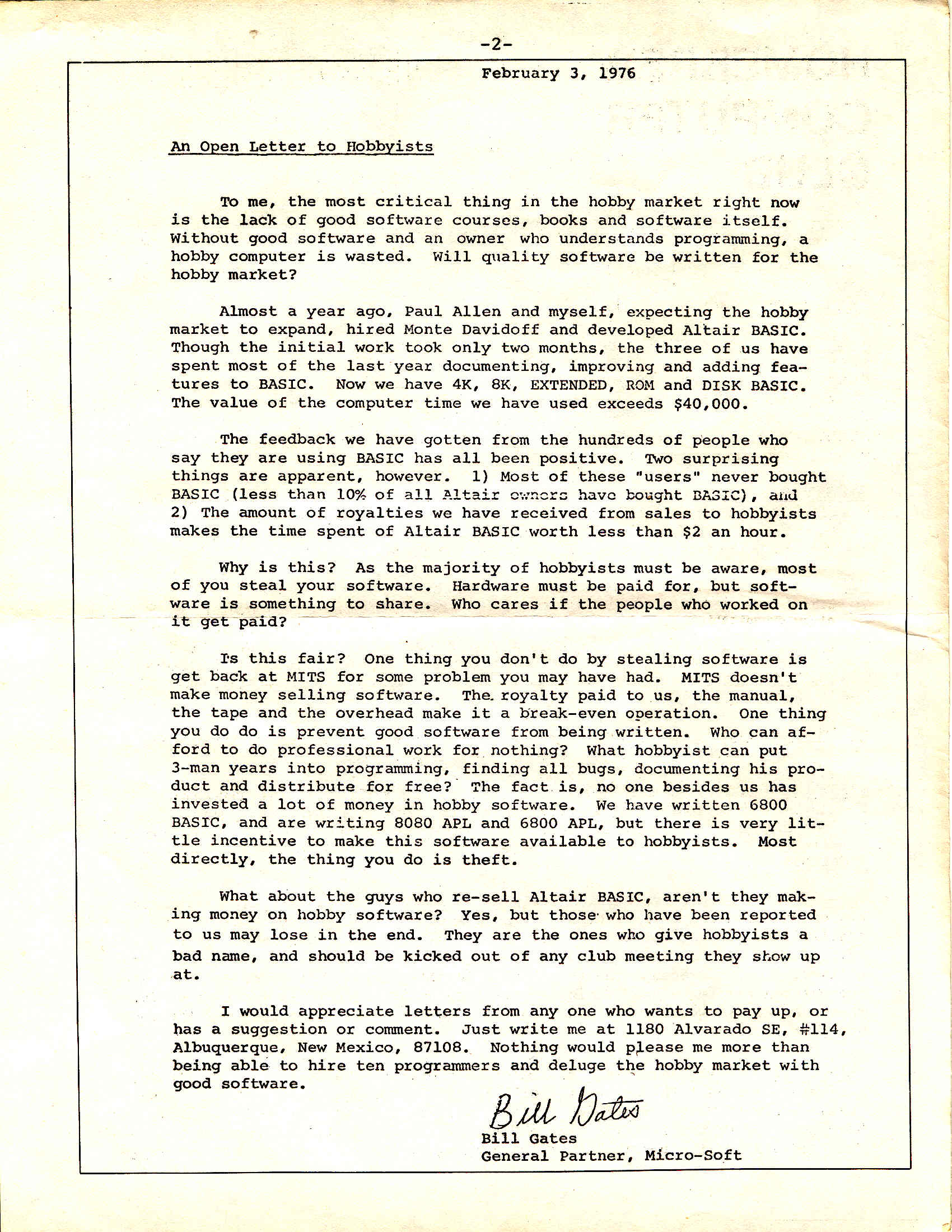
This early history of computing came to an abrupt end when Bill Gates from Micro-soft send an open letter to the Homebrew Computer Club.


AN OPEN LETTER TO HOBBYISTS

By William Henry Gates III

To me, the most critical thing in the hobby market right now is the lack of good software courses, books and software itself. Without good software and an owner who understands programming, a hobby computer is wasted. Will quality software be written for the hobby market?

Almost a year ago, Paul Allen and myself, expecting the hobby market to expand, hired Monte Davidoff and developed Altair BASIC. Though the initial work took only two months, the three of us have spent most of the last year documenting, improving and adding features to BASIC. Now we have 4K, 8K, EXTENDED, ROM and DISK BASIC. The value of the computer time we have used exceeds $40,000.

The feedback we have gotten from the hundreds of people who say they are using BASIC has all been positive. Two surprising things are apparent, however, 1) Most of these "users" never bought BASIC (less than 10% of all Altair owners have bought BASIC), and 2) The amount of royalties we have received from sales to hobbyists makes the time spent on Altair BASIC worth less than $2 an hour.

Why is this? As the majority of hobbyists must be aware, most of you steal your software. Hardware must be paid for, but software is something to share. Who cares if the people who worked on it get paid?

Is this fair? One thing you don't do by stealing software is get back at MITS for some problem you may have had. MITS doesn't make money selling software. The royalty paid to us, the manual, the tape and the overhead make it a break-even operation. One thing you do do is prevent good software from being written. Who can afford to do professional work for nothing? What hobbyist can put 3-man years into programming, finding all bugs, documenting his product and distribute for free? The fact is, no one besides us has invested a lot of money in hobby software. We have written 6800 BASIC, and are writing 8080 APL and 6800 APL, but there is very little incentive to make this software available to hobbyists. Most directly, the thing you do is theft.

What about the guys who re-sell Altair BASIC, aren't they making money on hobby software? Yes, but those who have been reported to us may lose in the end. They are the ones who give hobbyists a bad name, and should be kicked out of any club meeting they show up at.

I would appreciate letters from any one who wants to pay up, or has a suggestion or comment. Just write me at 1180 Alvarado SE, #114, Albuquerque, New Mexico, 87108. Nothing would please me more than being able to hire ten programmers and deluge the hobby market with good software.


Bill Gates

General Partner, Micro-Soft


This letter is a major schism in the discursive formation of copyright (to embrace some Foucault's notion). This letter bring a fundamental change in the discursive field where hardware and software aren't one anymore, and if you pay for the former, you have to pay for the later too. Programmers and users aren't one either. The first one is working and the later use the product, therefore he needs to pay for it. Those notion seems like self-going today, but they are made out, and the root can be trace back to this very letter, where Bill Gates accused hobbyists of stealing software.


DigiBarn Newsletters: Bill Gates' Open Letter to Hobbyists in Homebrew Club Newsletter Vol 2, Issue 1 (Feb 3, 1976). http://www.digibarn.com/collections/newsletters/homebrew/V2_01/gatesletter.html.


Foucault, Michel. 1969. L'archéologie Du Savoir. Bibliothèque des sciences humaines. Paris: Gallimard.


Gates, Bill. 1976. An Open Letter to Hobbyists. Homebrew Computer Club newsletter 2, no. 1 (February 3): 2.


Wednesday, February 18, 2009

And here goes anonymity...

Taken from: Raymond, Eric S. 2001. How To Become A Hacker. http://www.catb.org/~esr/faqs/hacker-howto.html.

Finally, a few things not to do.

  • Don't use a silly, grandiose user ID or screen name. 
[...]

The only reputation you'll make doing any of these things is as a twit. Hackers have long memories — it could take you years to live your early blunders down enough to be accepted.

The problem with screen names or handles deserves some amplification. Concealing your identity behind a handle is a juvenile and silly behavior characteristic of crackers, warez d00dz, and other lower life forms. Hackers don't do this; they're proud of what they do and want it associated with their real names. So if you have a handle, drop it. In the hacker culture it will only mark you as a loser.